
When College Football Enters the Admissions Office
What football reveals about how students choose colleges
College admissions has an unlikely accelerator: football. When a team wins — or even just captures national attention — applications rise, out-of-state interest grows, and the university’s brand moves up in a hierarchy that teenagers pay closer attention to than adults might assume.
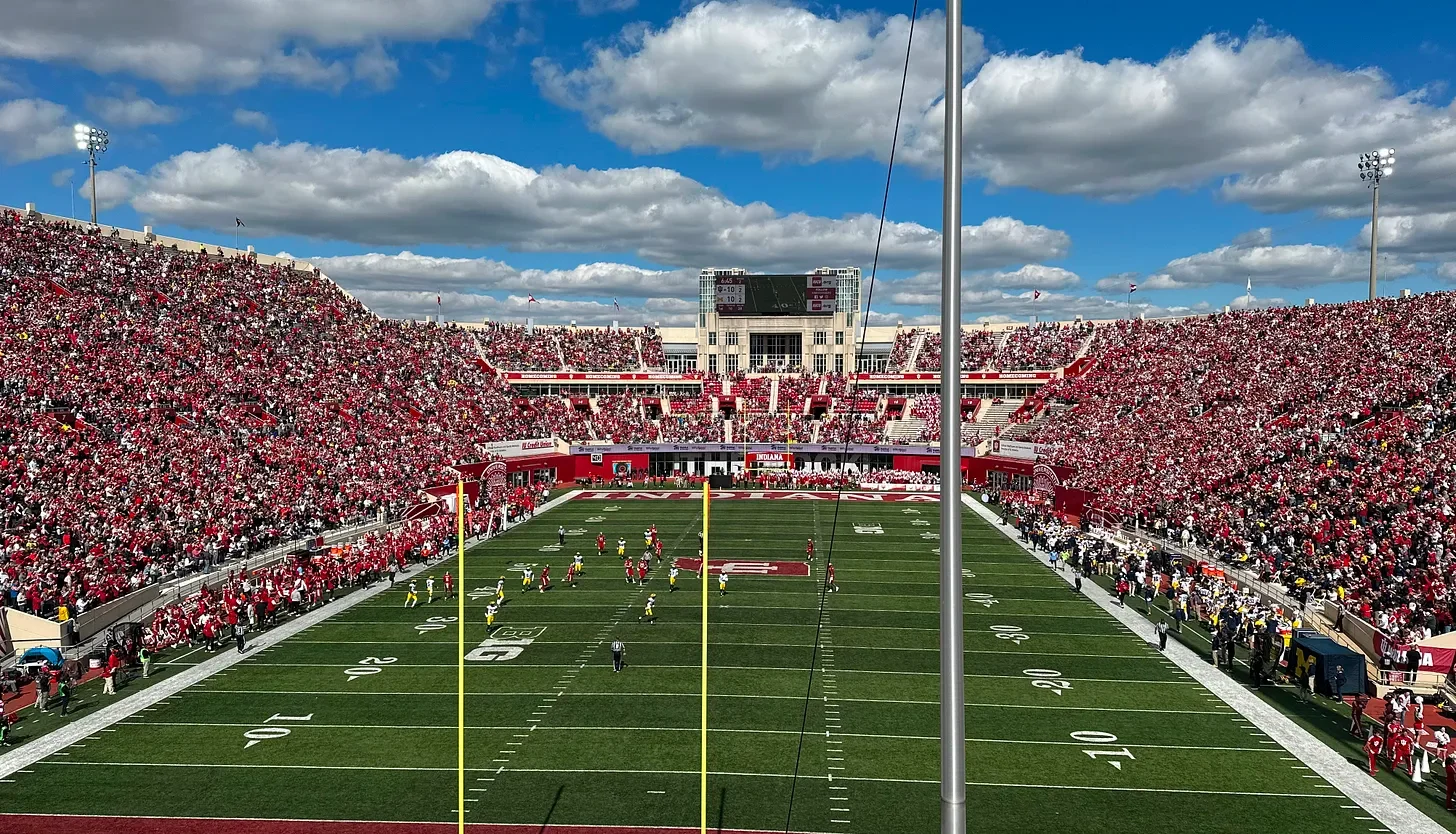
The Cinderella story of the year is Indiana University’s meteoric rise as a football school under the leadership of Curt Cignetti. A billionaire donor, a record-breaking sponsorship, and skyrocketing ticket sales certainly impact the school’s bottom line. But the tuition revenue generated by out-of-state students, who now represent nearly 50% of the student body and each pay $30k more per year than their in-state counterparts, is staggering.
What football reveals about how students choose colleges
College admissions has an unlikely accelerator: football. When a team wins — or even just captures national attention — applications rise, out-of-state interest grows, and the university’s brand moves up in a hierarchy that teenagers pay closer attention to than adults might assume.
The Cinderella story of the year is Indiana University’s meteoric rise as a football school under the leadership of Curt Cignetti. A billionaire donor, a record-breaking sponsorship, and skyrocketing ticket sales certainly impact the school’s bottom line. But the tuition revenue generated by out-of-state students, who now represent nearly 50% of the student body and each pay $30k more per year than their in-state counterparts, is staggering.
The University of Tennessee is another recent example of football’s influence on admissions. In 2020, the University of Tennessee–Knoxville received just over 25,000 applications. Football wasn’t driving national interest, and the team finished the 2021 season at 7–6. But under coach Josh Heupel, everything changed. In 2022, Tennessee went 11–2 and finished No. 6 in the national polls — its best season in two decades.
The admissions cycle that followed saw more than 50,000 applications, double what the university had received three years earlier. The 2023 football season produced another strong run at 10–3 and a berth in the College Football Playoff. This fall, applications jumped again to 63,000, including more than 46,000 from out-of-state students.
Sports success functions here as a visibility engine. Students apply to schools they know, and athletics — particularly football at large public universities — make universities culturally visible in the teenage imagination long before academic criteria are formed.
This phenomenon isn’t new. It was documented decades ago as the “Flutie Effect,” when Boston College’s applications spiked after Doug Flutie’s famous 1984 Hail Mary touchdown. What followed wasn’t just a short-term surge — it was a durable case study in how athletic success can change the external perception of a school almost overnight.
Let’s also examine James Madison University’s application surge after joining the FBS and Sunbelt League for the 2023 season. JMU received nearly 45,000 applications this fall in the midst of a 12-1 regular season record and berth in the CFP. The record-breaking applications marked a 34% increase from 2023 and a first-ever even split between in-state and out-of-state applicants. Coincidence?
The University of Colorado-Boulder offers an alternate version of the effect, one that doesn’t require winning at all. After hiring Deion Sanders, the university became a cultural storyline almost overnight. Sanders generated unprecedented media exposure, social media engagement, and national curiosity.
The application cycle that followed saw Colorado’s undergraduate applications rise roughly 20 percent to 68,000, despite the team not producing a winning season. For many teenagers, Boulder became a school worth considering not because of academics or rankings, but because it suddenly existed in their cultural field of vision.
If admissions were purely academic, Nobel Prizes would drive more applications than bowl games.
From the admissions side, the mechanism is surprisingly consistent: visibility leads to consideration, consideration leads to applications, and applications lead to selectivity. Universities understand this incentive structure well. More applications allow schools to admit a smaller percentage of students, which improves their selectivity metrics and, eventually, the rankings and reputational signals that donors, parents, and legislators monitor.
There is a feedback loop at work. Winning (or buzzing) teams generate media exposure and cultural presence. That presence expands a school’s audience. That audience becomes an applicant pool (often including more higher-paying out-of-state students). A larger applicant pool increases selectivity. Selectivity increases prestige. Prestige attracts more donors, which funds more athletics — and the loop continues.
From the student side, the psychology is simpler. Teenagers often use proxies for quality before they know what quality means. Sports success is an easy proxy to interpret. It signals energy, community, and belonging. It signals that something exciting is happening there. It signals that the school has a brand worth affiliating with.
In my work as an independent college consultant, I’ve seen this firsthand. When Colorado hired Deion Sanders, I heard the school’s name more in one year from students than in the previous five years combined. Tennessee began appearing on lists from students who had never been to Knoxville. Clemson and Georgia saw similar visibility gains during their championship years. These stories are not about curriculum; they are about attention.
If admissions were a purely academic marketplace, Nobel Prizes would drive more applications than bowl games. Most teenagers don’t follow Nobel Prize announcements, but they know who Coach Prime and Curt Cignetti are. They follow sports, social media, and cultural narratives. Universities know this, and some have quietly recalibrated their strategies accordingly.
College admissions is often described as opaque, but one of its dynamics is surprisingly clear: universities behave like brands operating in a competitive marketplace. Winning football games — or simply looking like a program on the rise — happens to be one of higher education’s most reliable brand-building tools.
And perhaps this isn’t as irrational as it looks. For many students, college isn’t just an academic choice — it’s a four-year experiment in belonging. Football simply gives them a visible place to imagine themselves.
WHAT TO DO WITH ALL THOSE APPLICATIONS? IT’S A BUSINESS DECISION
Each spring, after most decisions are in, the Midwest College Consulting team devotes significant time to reflecting on the application cycle and how emerging and previous admission trends impacted the process and our students’ results. Understanding how events and movements in college admissions alter the landscape and impact outcomes is critical to college advising. Ours is not a formulaic approach; along with our experience, we rely on industry developments to inform our highly individualized guidance for each student. As I sat down to summarize what we learned this season, I realized nearly everything I noticed boiled down to the business decisions colleges needed to make. Needing some separation from the project at hand, I came upon this quote from Leonard Sweet. Initially, I meant to use it as a message to graduating seniors. Upon further reflection, I realized it’s also meaningful to our work as college advisors. Nothing is passive about this job, entering college for the first time, or life.
Reflecting on 2024 Admission Trends
Each spring, after most decisions are in, the Midwest College Consulting team devotes significant time to reflecting on the application cycle and how emerging and previous admission trends impacted the process and our students’ results. Understanding how events and movements in college admissions alter the landscape and impact outcomes is critical to college advising. Ours is not a formulaic approach; along with our experience, we rely on industry developments to inform our highly individualized guidance for each student. As I sat down to summarize what we learned this season, I realized nearly everything I noticed boiled down to the business decisions colleges needed to make. Needing some separation from the project at hand, I came upon this quote from Leonard Sweet. Initially, I meant to use it as a message to graduating seniors. Upon further reflection, I realized it’s also meaningful to our work as college advisors. Nothing is passive about this job, entering college for the first time, or life.
“The future is not something we enter. The future is something we create.” -Leonard Sweet
At MCC, we take enormous pride in our students’ successes. We recognize the hard work they commit throughout high school and the effort and emotion they invest in the application process. We also know most of our students will create their own path in college that leads to their success. If you are a senior accepted to your dream school with a dauntingly low acceptance rate, or you chose a less selective college because it meets your needs in whichever ways are meaningful to you and your family, we congratulate you.
As college advisors, we bear the challenge of supporting our students’ dreams while managing expectations. The college admissions landscape has made that challenge more pronounced. So, as we navigate this fine line, we turn to recent admission trends to reflect on the college admissions experience for the Class of 2024 and how best to respond as we help the Class of 2025 finalize college lists and develop applications and essays.
1. Application Volume Surges (Again)
College applications have soared, and there is no sign of a slowdown. Common App’s volume increased by another 7% this year, contributing to the staggering 65% increase since the pandemic. Year-over-year growth occurred in both the number of colleges applied to per applicant and the number of applicants using the platform. So, what’s the impact of these whopping statistics? It’s more difficult to be admitted to popular schools, for one. The vast number of applications also makes it more difficult for colleges to manage their business. And that’s what colleges are, after all–businesses.
2. It’s Not Personal, It’s Business
This increased volume made it difficult for colleges to tell which students would say yes, and managing enrollment is critical to their bottom line. Colleges must protect their yield (percent of admitted students who end up attending) and hence lean on sophisticated predictive analytics to forecast who will enroll. They want each dorm bed to be occupied (but not over-occupied!). They need the right number of students studying various majors (not too many or too few), so tenured professors have full classrooms (but not too full). They also need enough full-paying students to meet tuition revenue benchmarks. All of this is a balancing act. Schools’ institutional priorities drive their decision-making. Top students are sometimes denied because they don't meet the institutional need to fill specific mystery slots. Even if you are a well-qualified applicant, your admission chances may be much lower than the reported acceptance rate when you account for institutional priorities such as geographic location, major and colleges within the university, athletic recruiting, gender, or specific talents.
3. Deferrals and Waitlists Buy Colleges Time
Wild percentage increases in applications create unpredictability, so colleges leveraged deferrals and waitlists to see if enough admitted students would say yes so they could then fill potential remaining seats in late spring and summer. The colleges’ yield challenge (is this well-qualified student really going to attend?) and the need to meet specific institutional goals meant more students whose profiles were well within or even exceeded the colleges’ admittance criteria were deferred. Sometimes, colleges genuinely defer students to reevaluate their applications alongside the regular decision pool; however, deferrals and waitlists are also used to gauge the applicant’s interest, appease legacies and donors, and allow colleges to handpick students who fill institutional priorities (think underrepresented majors, unrepresented states, specific talents, first-generation, full pay, and more). While we occasionally witness students accepted from deferrals and, in rarer cases, waitlists, the statistics paint a picture that gives pause.
*University of Michigan Waitlist STATISTICS
2023: 21,000+ offered spot on waitlist. 15,000 accepted. 77 admitted. Waitlist acceptance rate: 0.51%
2022: 17,805 offered spot on waitlist. 13,000 accepted. 68 admitted. Waitlist acceptance rate: 0.52%
*Source: Common Data Set
CONSIDER OUR ADVICE: Rather than applying to a longer list of similar colleges (e.g., 12 East Coast liberal arts colleges), focus on a few and devote time to learning about them, demonstrating interest, connecting with admissions, and visiting if possible. Prove your fit through your essays and other communication. Five solid applications will yield better results than ten random applications to colleges that evaluate students holistically.
4. Being Qualified or Even Overqualified Isn’t Always Enough
Many private schools filled half (or more) of their class through binding early decision, leaving fewer spaces than ever for regular decision applicants. Even early-round statistics have plummeted (see chart below). With increased applications, it is harder to stand out. This is not to say strong students were not rewarded in the admission process - they often were; however, having a balanced list is more important than ever.
It’s also important to recognize that every student who applies to a 20% acceptance rate school doesn’t have a 20% chance of being admitted. That holds for applicants to higher acceptance rate schools as well. With vastly increased application numbers at traditional “safety” schools, we can no longer be as confident that a school is a sure bet. It’s also essential to look at recent admission trends and updated admitted student profiles because those statistics have changed dramatically in the past two years.
2023-2024 ACCEPTANCE RATES FROM THREE ELITE SCHOOLS
Vanderbilt Early Decision Acceptance Rate: 15.2% — Regular Decision Acceptance Rate 3.7%
Duke Early Decision Acceptance Rate: 12.9% — Regular Decision Acceptance Rate 4.1%
Yale Restrictive Early Action Acceptance Rate: 9.02% — Regular Decision Acceptance Rate: 2.75%
CONSIDER OUR ADVICE: It’s increasingly important to have safety and target schools, especially for top students, and show interest in those schools. Even schools you consider as safeties or targets defer, waitlist, or even deny overly or highly qualified students as a way to manage their yield. So what should you do? Show interest! Make them feel they’re your favorite. Visit in person if possible! Interview if given the chance. Don’t view your safety or target as a shoo-in. Being qualified isn’t always enough to gain admission.
5. Skyrocketing Application Volume at State Schools = Less Predictable Outcomes
While the meteoric drops in admit rates at elite colleges may claim the headlines, highly competitive schools aren’t the only ones impacted by this growth. Even state flagships formerly considered less selective have seen vast increases in their applicant pools and strikingly low acceptance rates as a result. Requiring test scores doesn’t appear to sway applicant volume negatively. Florida State University saw a 28% increase in applications, with students admitted from the 76k applicants averaging a mean ACT score of 31. Being one of the first institutions to return to requiring test scores did not hinder the University of Tennessee’s growth either. The Knoxville-based flagship received almost 11k more applications than last year, resulting in an even lower acceptance than previously could have been imagined. Tennessee’s 23.7% out-of-state admit rate has propelled it from a long-standing safety school among some of its traditionally more selective neighbors to a school that only students with top statistics are admitted.
CONSIDER OUR ADVICE:Be open to adding 2-3 less selective colleges in a broader geographic region, particularly if you apply test-optional. Pay attention to testing policies, and know that large universities that require scores rely heavily on them in evaluating applicants. Straight A’s may not compensate for test scores that fall on the low end or below the range for admitted students. Similarly, a high test score does not compensate for a lower GPA than other applicants. Look up last year’s admitted class profile and be realistic about your chances if your scores or grades fall outside the published range.
6. Alternate Pathways to Admission Rise in Popularity
Northeastern University, Clemson University, University of Florida, Florida State University, College of Charleston, University of Colorado, Case Western University, Tulane University, University of Miami, Penn State University, Georgia Tech. What do these colleges have in common? They offer some students acceptance with provisional terms. This year, we saw more acceptances conditional on students participating in first-semester or year-long study abroad programs, first-year online learning, summer and spring start programs, bridge programs through community college, and guaranteed transfer offers. Alternate pathways to admission are another response to enrollment unpredictability, providing colleges a way to fill seats vacated by transfer students, students studying abroad, and students who graduated early, and to admit borderline students without having to publish their GPA/test scores or report them to ranking publications.
CONSIDER OUR ADVICE: While these nontraditional offers aren’t necessarily what students hope for, we recommend keeping an open mind. Provided the terms of enrollment don’t impose a cost barrier, they can offer a unique experience and a path to a college you want to attend.
Planning for Standardized Testing
Nearly all colleges adopted a test-optional policy during the pandemic, and most remained test optional for the class of 2023. Some schools were test-optional before Covid as well. However, test-optional does not mean you shouldn’t test or send scores. Some colleges are returning to pre-pandemic testing requirements, including MIT, Purdue, Georgetown, and many large state universities in the South, including the University of Tennessee, the University of Georgia, and all Florida public colleges. We recommend all students prepare for the ACT or SAT and take it more than once. Once your testing is complete, compare those results to the policies and admitted student profiles of your colleges. If your scores fall within the middle 50% of accepted students, it usually makes sense to submit them. If you don’t do as well as you hope, the good news is there will be plenty of colleges to which you can apply without scores.
TEST OPTIONAL
Nearly all colleges adopted a test-optional policy during the pandemic, and most remained test optional for the class of 2023. Some schools were test-optional before Covid as well. However, test-optional does not mean you shouldn’t test or send scores. Some colleges are returning to pre-pandemic testing requirements, including MIT, Purdue, Georgetown, and many large state universities in the South, including the University of Tennessee, the University of Georgia, and all Florida public colleges. We recommend all students prepare for the ACT or SAT and take it more than once. Once your testing is complete, compare those results to the policies and admitted student profiles of your colleges. If your scores fall within the middle 50% of accepted students, it usually makes sense to submit them. If you don’t do as well as you hope, the good news is there will be plenty of colleges to which you can apply without scores.
TEST PREP
MCC is extremely fortunate to have test prep expert Kelley Ching on our team. Kelley has prepared students virtually and in person for the ACT, SAT, and PSAT for over 25 years. She takes a highly personalized approach with each student and devises a plan to meet their individual needs and score goals. Kelley earned her master’s degree in education from Stanford University and her BA from UC Berkeley. Kelley’s teaching background and tutoring experience distinguish her from many independent tutors and test prep agencies. Email kelley@midwestcollegeconsulting.com or your consultant to inquire about her availability.
We recommend test prep before all tests, including the first one. Learning math and grammar content, in addition to strategies for the various sections, is important. It can be helpful to take a timed practice test at home or a proctored/timed practice test for a benchmark score before you begin your prep. Timed practice tests as part of test preparation are critical to preparing for the ACT and SAT. You can find them online or in the study guides.
This ACT study guide is the standard resource many tutors use and is also great for independent studying. Amazon link: The Official ACT Prep Guide. For SAT tests through 2023: The Official SAT Study Guide.
WHEN TO TEST
The ideal testing time frame depends on many factors, including your coursework and commitments outside of school/availability for test prep. For students who have completed Algebra II, it often makes sense to prepare over the summer before junior year and take the first test in July or September. Once those results are available, you can reassess to determine your additional test prep needs and choose retesting dates. If your summer is too busy to devote time to test prep, you can prepare in early fall and take the first test in December. As you plan, also keep in mind that many high schools offer a free ACT or SAT during the school day in February, March, or April.
For specific test dates, you can pay to receive the questions/answers after your test to use for future preparation. We recommend paying the additional fee if offered on your testing date: April, June, and September for the ACT; October, March, and May for the SAT. Please double-check these dates because changes are underway.
An additional factor to consider is that the College Board announced that the SAT is switching from a paper/pencil test to a digital adaptive version. Administrations of the paper test will only be available through the end of 2023. The 2023 PSAT will be administered in the new digital format and may be a good indicator of whether this version is a good fit for you. For more information about the digital SAT, click here.
WHICH TEST?
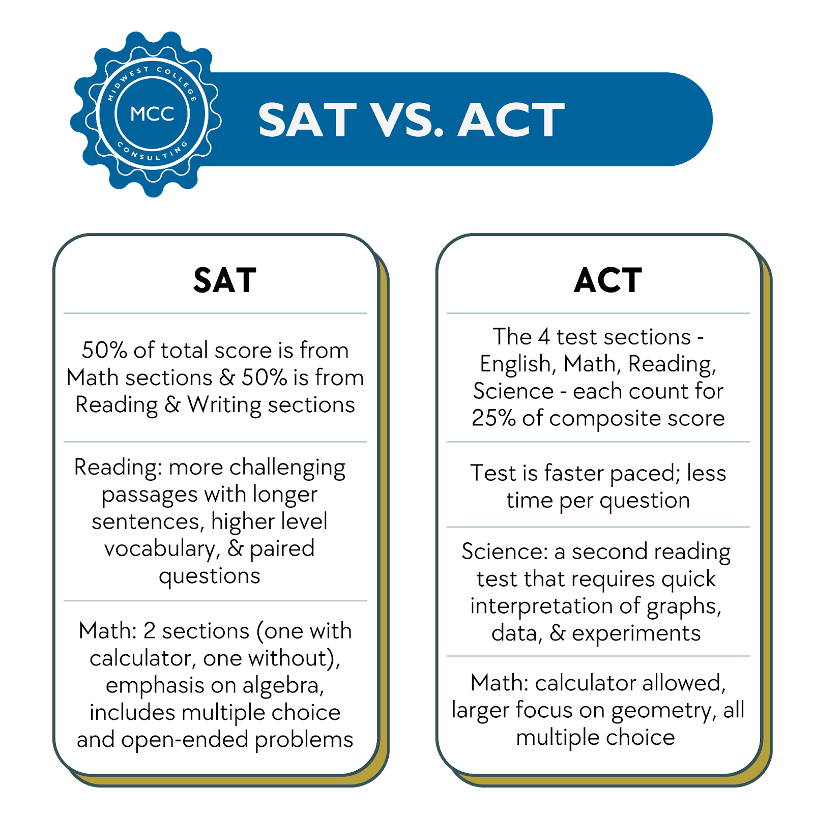
While colleges view the ACT and SAT equally, many students prefer one over the other. The choice should be deliberate based on the student’s strengths and preferences. Test prep should focus on either the ACT or SAT, and students should devote their energy towards improvement on that specific test.
REGISTERING
Plan and register ahead of time! The longer you wait to register, the fewer locations might be available for testing.
Use your proper name if you have a nickname. Your name should match the name on your high school transcript.
During registration, you will be asked to answer many questions for your profile. Many of these questions concern your high school courses, grades, and prospective academic area of interest. You are not required to complete most of these questions. If you decide to enter grades, do so only for A's.
The SAT eliminated its optional essay section, and most colleges have stopped considering the optional ACT writing section. When registering for the ACT, you can decline to sign up for the optional writing portion unless you are applying to West Point (where as of 2023, it is required).
AT MCC WE ADVISE STUDENTS NOT TO SEND FREE SCORES TO ANY COLLEGES AT REGISTRATION OR TESTING TIME. Based on the policies of your colleges and whether or not your scores will benefit your application, you can determine which scores to send to which colleges once your testing is complete.
LEARNING DISABILITIES/EXTENDED TIME: If you have a diagnosed LD or health condition with a 504 or IEP, you should request testing accommodations from the College Board and ACT. The process takes time, and a school official must submit the request for accommodations before the late registration deadline for the test (even if a student already receives accommodations at school). Requests can take 5-10 days to process, so don’t delay the accommodations process. In nearly all cases, the College Board and ACT will approve extended time/accommodations only if a plan is already in place and the student is actively using it at school. NOTE: Military Academies do NOT accept scores taken with accommodations.
THE DECISION PROCESS ISN’T ALWAYS ABOUT YOU
College applications have continued to spike since the pandemic, and there is no sign of a slowdown. This increased volume meant it was harder for colleges to tell which students were going to say yes, so they leveraged deferrals and waitlists to buy themselves time to fill potential remaining seats in late spring and summer. Some schools deferred and waitlisted students in such astronomic numbers that there is no way they’ll even scratch the surface of admission offers to those non-decisions. The yield challenge and the need to meet specific institutional goals meant more students were also denied from schools they might have been admitted to in the not-so-distant past. Compounding the situation is that some schools admitted fewer students due to housing crunches resulting from previous years’ over-enrollment.
College applications have continued to spike since the pandemic, and there is no sign of a slowdown. This increased volume meant it was harder for colleges to tell which students were going to say yes, so they leveraged deferrals and waitlists to buy themselves time to fill potential remaining seats in late spring and summer. Some schools deferred and waitlisted students in such astronomic numbers that there is no way they’ll even scratch the surface of admission offers to those non-decisions. The yield challenge and the need to meet specific institutional goals meant more students were also denied from schools they might have been admitted to in the not-so-distant past. Compounding the situation is that some schools admitted fewer students due to housing crunches resulting from previous years’ over-enrollment.
This year, we heard countless stories from families and colleagues about strong students who were denied to many schools on their overly selective lists. Many private schools filled half (or more) of their class through binding early decision, leaving fewer spaces than ever for regular decision applicants. With increased applications, it is harder to stand out. This is not to say strong students were not rewarded in the admission process - they often were; however, having a balanced list is more important than ever.
It’s important to recognize that every student who applies to a 20% acceptance rate school doesn’t have a 20% chance of being admitted. That holds true for less competitive schools as well. Just because a school admits 70% of its applicants does not mean every student has a 70% chance of being admitted. With vastly increased application numbers at traditional “safety” schools, we can no longer be as confident a school is a sure bet. It’s also essential to look at recent admission trends and updated admitted student profiles because those statistics have changed dramatically in the past two years, and most data found on the web is outdated.
As college advisors, we bear the challenge of supporting our students’ dreams while managing expectations. The college admissions landscape has made that challenge more pronounced with application volume, test-optional admissions, and increased emphasis on institutional priorities. Our first priority as advisors is to set our students up for success in terms of results and fit. So, as we navigate the fine line between managing expectations and buttressing dreams, we turn to recent admission trends and how best to respond to ensure better outcomes.
Following are some trends we noticed at MCC, many of which were echoed by colleagues, as well as the actions we recommend students in the class of 2024 take as they finalize college lists and develop applications and essays.
TREND: Top students not being admitted to selective schools. Just being qualified is no longer enough to get admitted.
RESPONSE: Schools’ institutional priorities drive their decision-making. Top students are denied not because they aren’t qualified but because they don't meet the institutional need to fill specific mystery slots. For example, a selective college in the northeast reported a 9.5% acceptance rate in 2023. However, this acceptance rate can be much lower when you account for institutional priorities. Of the 3230 admitted students, when you account for the need to admit students from underrepresented groups, achieve geographic diversity (admitted students represented all 50 states and numerous countries), fill seats in 3 different colleges and various majors within the university, admit athletic recruits, appease donors and legacies, and represent specific talents in music or the arts, you can imagine how low the admit rate actually is for a student who doesn’t fill one of those needs.
It’s increasingly important to have safety and target schools, especially for top students, and show interest in those schools. Even schools you consider as safeties or targets, especially private ones, defer, waitlist, or even deny overly or highly qualified students as a way to manage their yield - they want to offer admission spots to students they predict will accept. So what should you do? Show interest! Make them feel they’re your favorite. Visit in person if possible! Interview if given the chance. Don’t view your safety or target as a shoo-in. Being qualified isn’t always enough to gain admission.
TREND: More unpredictability/selectivity in state schools where application volume is skyrocketing.
RESPONSE: Be open to adding 2-3 less selective colleges in a broader geographic region, particularly if you apply test optional. Pay attention to test-optional policies and know that large universities that require scores rely heavily on them in evaluating applicants. Look up the last year’s admitted class profile and be realistic about your chances if your scores or grades don’t fall within the published range.
Headlines and class of 2027 admission statistics at three popular universities in the south
University of Tennessee
“Acceptance rate plummets by nearly 30% in most competitive year in UT history”
Out-of-state acceptance rate 33.3%
Average UT core (recalculated) weighted GPA 4.04–4.46
ACT composite score 26–31; SAT Composite score 1240–1400.
University of Georgia
Out of state acceptance rate: 26%
UGA Recalculated GPA Average: 4.19
Roughly 91% of the HS core grades were A’s
AP/IB/Dual Enrollment: average of 10+ courses
ACT Composite: 29–34 SAT: 1270–1470
Auburn University
“Auburn receives record number of applicants for fall 2023”
Early Action acceptance rate 44%
Average ACT 28.2 Average GPA 4.2
Fewer than 9% admitted test optional
TREND: Greater use of non-decisions including deferrals and waitlists
RESPONSE: Rather than applying to a longer list of similar colleges (i.e. 12 East Coast liberal arts colleges), focus on a few and devote time to learn about them, demonstrate interest, connect with admissions, and visit if possible. Prove your fit through your essays and other communication. 5 solid applications will yield better results than 10 random applications to colleges that evaluate students holistically.
TREND: Increased offers of acceptance with provisional terms. This is another response to unpredictability and provides colleges a way to fill seats vacated by transfer students and to admit borderline students without having to report their GPA/test scores for the rankings. More colleges offered conditional admission provided students agreed to spring enrollment, structured/sponsored Gap year or semester programs, or fee-based summer programs.
RESPONSE: While these offers aren’t necessarily what students hope for, we recommend keeping an open mind. Provided the terms of enrollment don’t impose a cost barrier, they can offer a unique experience as well as a path to a college you want to attend.